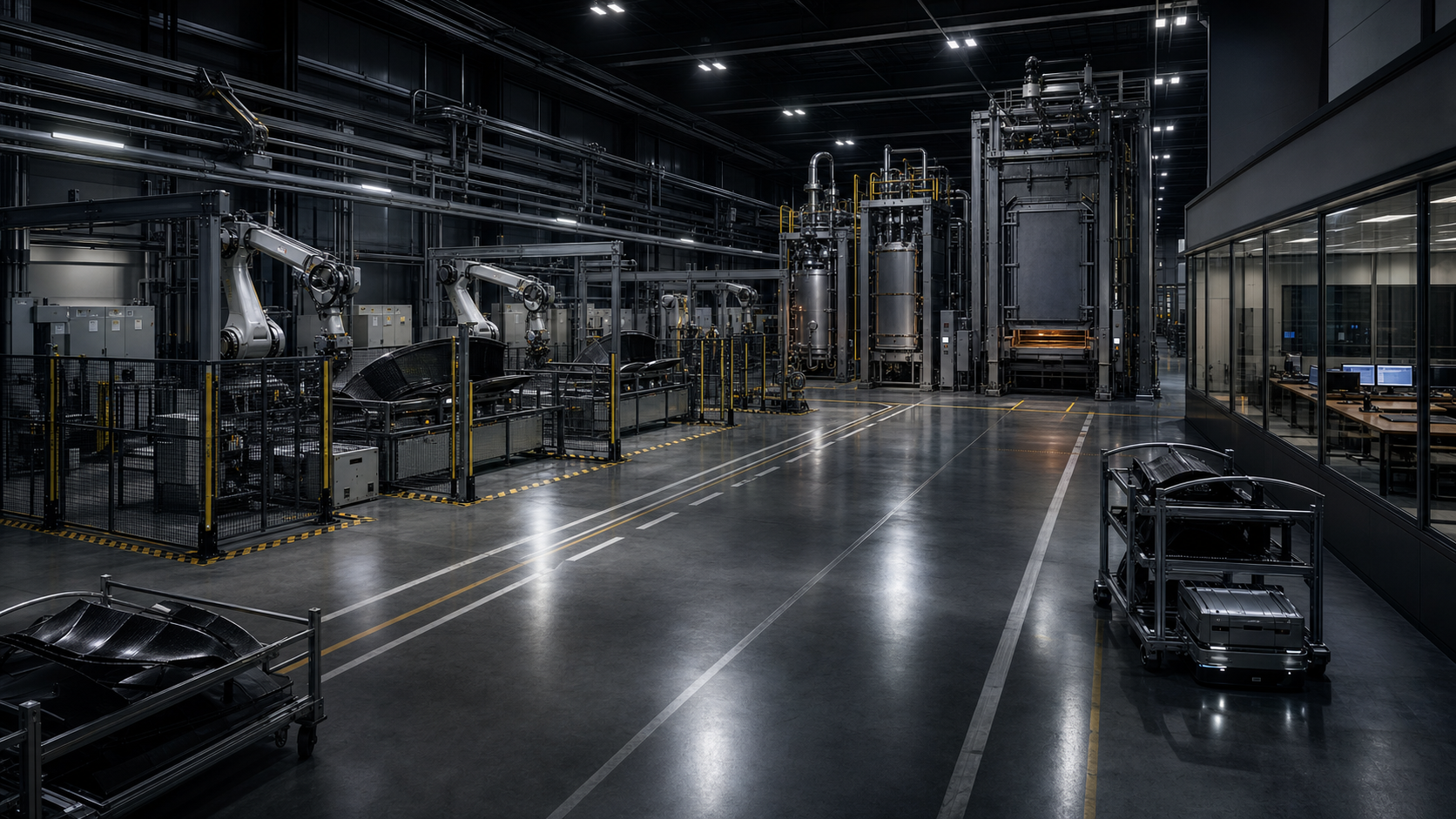

The Platform
A digital-first manufacturing system, built to industrialize extreme-temperature materials at scale.
The end-to-end advanced-materials platform that the next generation of aerospace, defense, energy, and industrial systems needs now.
Foundry 1, the first facility, is in development, with more facilities to follow as the platform scales.
The Bottleneck
The most ambitious next-generation aerospace and defense systems are not limited by performance. They are limited by the economics of producing advanced ceramic composites at scale.
Radian's own hardware program (the Radian One spaceplane) proved the constraint firsthand. The same bottleneck constrains the broader advanced-systems market. America needs the industrial base to build advanced composites at scale, now.
Radian is building the scalable manufacturing platform to change that.
Demystifying the Technology
CMCs combine ceramic heat resistance with composite strength and low weight, reshaping high-performance systems. The advanced composites market is converging around one critical material.
70%
Lighter than advanced superalloys.
300°C
Higher maximum operating temperature.
You already rely on ceramic composites. The same family of materials turns up wherever heat, speed, and reuse meet:
Jet engine hot sections
Turbine shrouds and blades that run hotter and lighter, for more thrust and better fuel burn.
High-performance car brakes
Carbon-ceramic discs that take repeated extreme heat without fading and last far longer than steel.
Rocket nozzles and re-entry shields
Surfaces that survive re-entry-grade temperatures and can fly again.
The ambition of modern engineering has outpaced the economics of manufacturing.
“Ceramic matrix composites are poised to be the next material revolution… Analogous to carbon fiber reinforced composites in the mid-80s, CMCs are poised for explosive growth.”
The Solution
An independent, automated, end to end CMC production line, open to every customer.
Purpose-built to improve yield, increase cadence, and structurally compress cost. Fabrication, thermal processing, finishing, quality control, and digital process control one integrated platform. This is how scalable CMC production becomes a national capability.
Preform fabrication, densification, and inspection engineered as one coordinated system, not siloed steps.
Robotics, controlled fiber placement, and programmable high-temperature processing designed to systematically reduce variability, scrap, and manual intervention.
Process modeling, digital twins, and AI-enabled process control compress cycle time, stabilize throughput, and structurally lower cost to optimize yield.
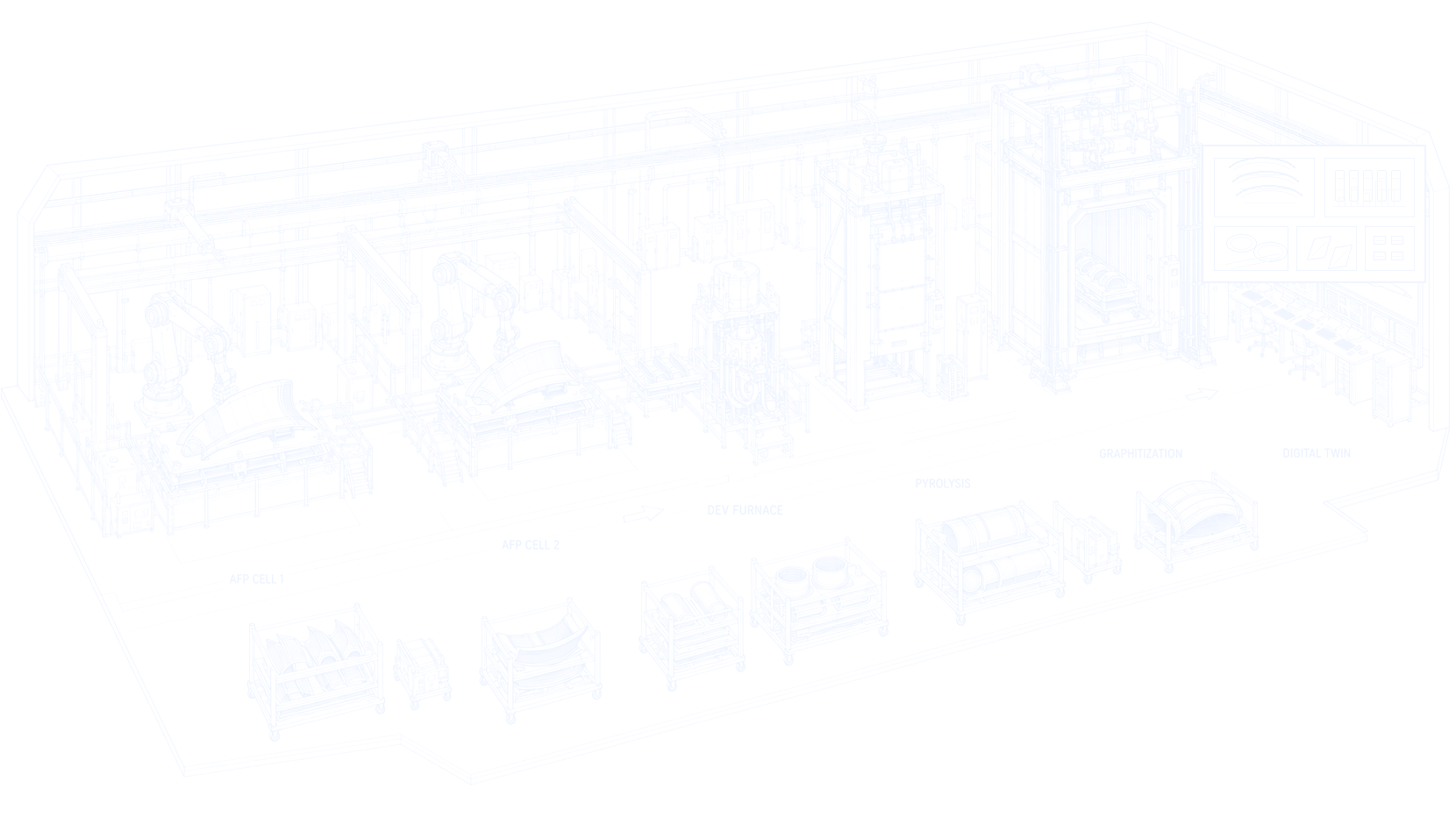
Hover the markers for each station. Stations in order: preform fabrication (AFP cells 1 and 2), pyrolysis furnace, graphitization furnaces, digital twin.
Every major piece of the Foundry's technology already exists. Radian is integrating it.
We call it the Foundry deliberately. The material is proven; the barrier is the process. What Radian is building is the process knowledge, the furnace infrastructure, and the qualification discipline that turn a known material into parts customers can order.
Inside the Foundry
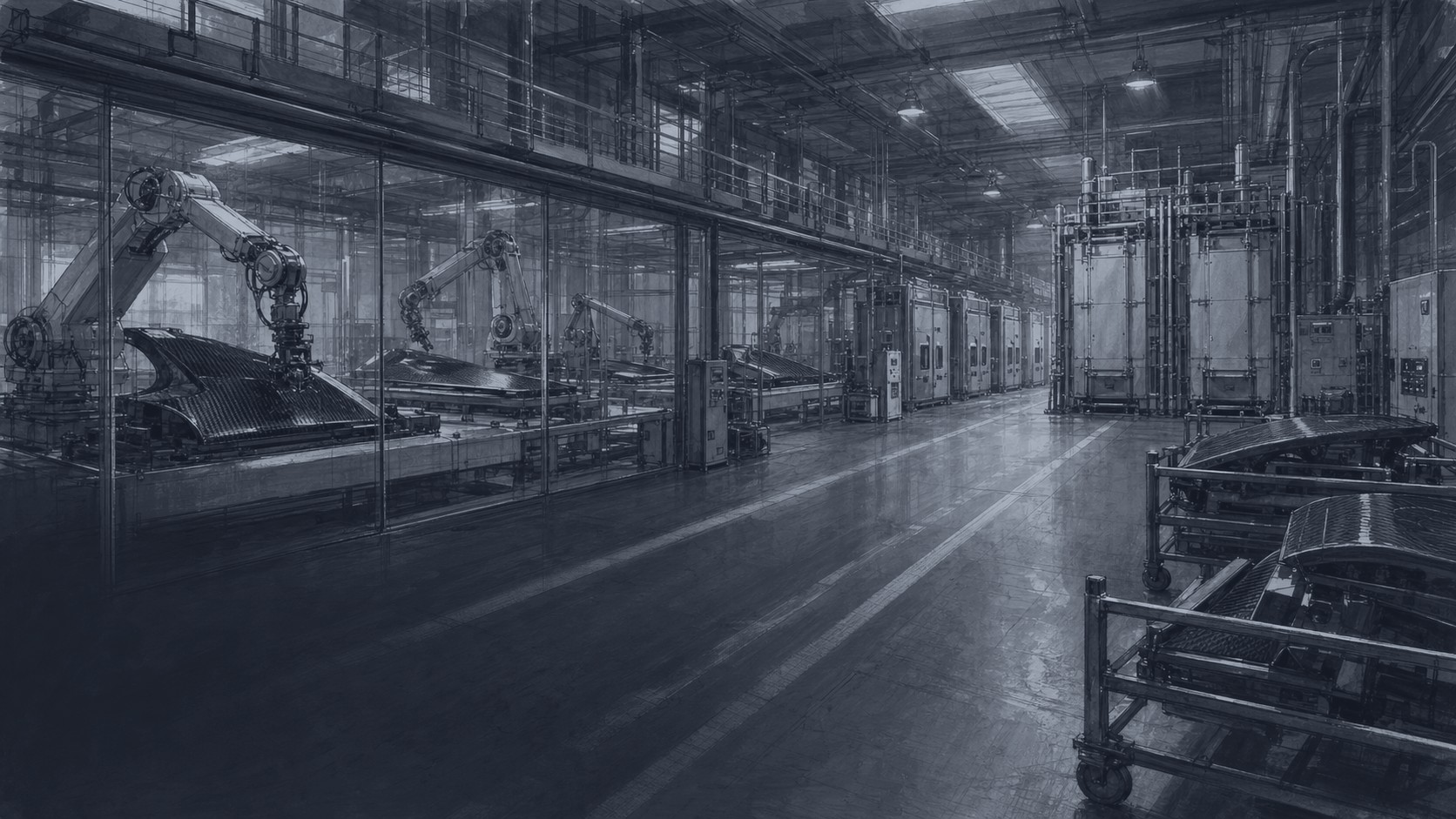
Automated fiber placement cells feed a multi-furnace, high-temperature processing chain that turns composite preforms into finished ceramic-composite parts.
Pyrolysis
Densification
1100°C
Graphitization
High-temperature processing
2400°C
Running these high-temperature steps reliably, and automating them, is the hard part. It is what turns ceramic composites from largely hand-built, one-at-a-time parts into predictable production at scale.
Dur-E-Therm TPS
Designed to protect Radian One from extreme hypersonic re-entry heating and to insulate cryogenic propellant tanks without cryopumping or icing. Dur-E-Therm moves beyond shuttle-era materials with superior lifespan, operability, and operating envelope. The same TPS architecture supports Dur-E-Therm Industrial for terrestrial high-temperature applications.
Hot-fired at NASA Glenn to ~1,480°C through repeated ascent and re-entry profiles, including two 120-minute hypersonic test runs. Patent pending.
Designed to survive repeated re-entry without burning away, unlike single-use ablative heat shields.
Longer life, a wider operating envelope, and easier operability than legacy thermal protection.
One architecture serves re-entry heat shielding, cryogenic tank insulation, and terrestrial high-heat industry.
Testing performed at NASA facilities under Space Act Agreement. Does not imply NASA endorses Radian or its products. Tests were ground simulations of flight profiles.
Cost Economics
The Foundry is designed to succeed where CMC industrialization has stalled. It targets a ~50% reduction in manufacturing cost by improving three structural drivers of CMC economics.
Driver 1
Automated fiber placement at production cadence, replacing hand lay-up.
Driver 2
Furnace infrastructure and process control to compress pyrolysis and graphitization cycles.
Driver 3
Digital twin and integrated quality control across the chain.
Target from Radian's internal cost model for Foundry 1. The Foundry has not yet operated; targets are unproven.
Radian One development cost, as the Foundry scales
Markets We Serve
A market forming across four categories, all converging on the same capacity shortage.
Spaceplanes, capsules, upper stages, rocket nozzles.
Glide vehicles, interceptors, structures, advanced propulsion.
Gas turbines, nuclear and hydrogen power and storage.
Data-center and semiconductor cooling, high-performance braking.
Every one of these markets needs the same CMC capacity, and it does not exist at scale today.
Offerings
Process development, qualification, and pilot-scale production for advanced composite structures.
Engineering, simulation, and CMC processing for partner programs from concept through qualification.
Materials modeling, process simulation, and digital-twin services across the production chain.
High-temperature CMC parts for aerospace, defense, and industrial use.
Thermal protection system parts for repeated re-entry without ablation.
High-temperature CMC parts for industrial high-heat environments.
Advanced composite materials supporting the broader manufacturing chain.
Roadmap
The Foundry is the business, and it scales first. Over the long term, it also makes Radian One, the spaceplane, possible.
The first advanced-materials foundry comes online and begins producing high-temperature ceramic composites for customers.
A second, larger facility brings ceramic-composite manufacturing to full industrial scale.
Radian One, the spaceplane the Foundry makes possible, takes to the air.
Routine, on-demand access to orbit, the long-term mission realized.
Where it fits
The Foundry industrializes extreme-temperature materials for aerospace, defense, and industry. It also makes Radian One affordable to fly.